
Services
Mechanically Polished Concrete Floors


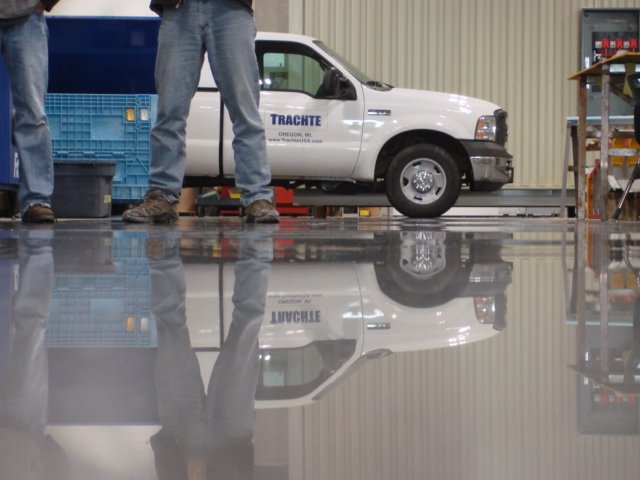
Most often, contractors are unlikely to utilize the same equipment, tooling, chemicals/materials, and processes. Because of that, the buyer receives different quotations and results for Polished Concrete. When a buyer decides which contractor to use, they should consider that not all floors are polished the same or last a long time. The following is how we approach each floor.
Concrete Floor: The factors that are most influential to the final look and luster of the existing concrete floors are as follows:
- The floor’s hardness as determined by the original mix design. The concrete admixtures such as fly ash and slag should not exceed 20% for a 3,500 psi slab and not exceed 25% for a 4,000+ psi slab. Higher levels will reduce the abrasiveness and strength.
- The flatness and/or levelness are important. High and low areas will result in varying aggregate exposure and distort the glassiness of the floor which lends to an uneven polished appearance.
- Air entrainment should be less than 3% and concrete should not have fiber reinforcement.
Equipment: Mechanically grinding the concrete utilizes industrial diamonds and hardeners to level, densify, polish, and protect the floor with a topical guard. Equipment factors that affect the final floor’s quality and look are the weight of the grinder, speed, width, and rotation of the tooling. To meet OSHA requirements for dust control we use a combination of water and Hepa filtration vacuums.

Diamond Tooling: We have seen the best results using select metal diamonds and hybrid resin diamonds. Based on the floor’s condition, we normally follow this sequence. Starting with 80-grit rhombus metal diamonds (used in most cases), vacuum and/or scrub the floor, and apply the Peldex Reactive Colloidal Lithium Densifier. After *nano-gelation of the densifier takes place and the floor is dry, we follow with 100-grit resin hybrid pads. Depending on the desired look, we can apply the Peldex Topical Guard and run a high-speed burnisher to complete the process. If desired, we will polish the floor with 200-grit diamonds and then apply a polished concrete guard. The same process can be followed with 400-grit for a higher luster. In most cases, it will be difficult to visually distinguish between the 100, 200, and 400-grit luster levels. All levels show a similar shine and reflectivity. There is no need to continue with 800, 1500, and 3000-grit because of the advanced properties of the Peldex products that we use.
Chemicals: There are many densifiers to choose from, such as sodium, potassium, lithium, or blends. We have found that the Peldex Reactive Colloidal Lithium densifier works the best for our purposes. Its chemistry reacts to the existing concrete giving us a more densified and lustrous floor. We use Peldex because it deeply penetrates the slab and reacts to the existing alkali within the pores and capillaries of the concrete. This *nano-gelation reaction is completed in 24 hours and turns into a hardened gel which densifies, mitigates moisture, and prevents chemical staining. Finally, after the polishing, we apply multiple coats of Peldex Topical Guard. When the Peldex Topical Guard is dry, we burnish the floor with a high-speed burnisher to a quality luster with great abrasive and chemical protection.
*Nano-gelation reaction – This is the time period (normally 20-30 minutes) for Peldex’s proprietary formulation to react with the existing alkaline within the concrete. Peldex is drawn into the micro-pores and capillaries in concrete and becomes a permanent part of the concrete. This helps to prevent water transmission and maintain a hardened floor. Note that Peldex will not stop water transmission from larger openings on or in the floor (saw cuts, expansion joints, etc.). Patching materials will be used in those areas.
Concrete Coatings
Because there are so many coatings that can be applied, give us a call and we can see what we can do for you.